Article Table of Contents
At a glance, most e-commerce websites look pretty similar.
A clean homepage, product photos, a shopping cart, and a checkout button. Whether it was built with an ecommerce website maker or by a professional e-commerce website team, the surface often feels the same.
But behind the scenes, there’s a massive gap between stores that quietly generate revenue every day and those that struggle to make a single sale.
It’s rarely about the product alone.
Some online stores just feel easy to trust. They load quickly, work properly on mobile, and make buying simple. Others feel clunky, outdated, covered in popups, or confusing within seconds. That’s usually where potential customers leave and never come back.
The stores that succeed long term are usually the ones that make everything feel easy. Easy to browse, trust, and purchase from.
When that experience is backed by clear messaging, reliable performance, and strong local visibility, consistent growth becomes much more realistic.
The Best E-Comm Stores Make Buying Effortless
The highest-performing e-commerce stores all share one trait: they’re easy to use:
- Navigation feels natural
- Product categories make sense
- Important details are easy to spot
- Product pages answer questions before customers need to ask them
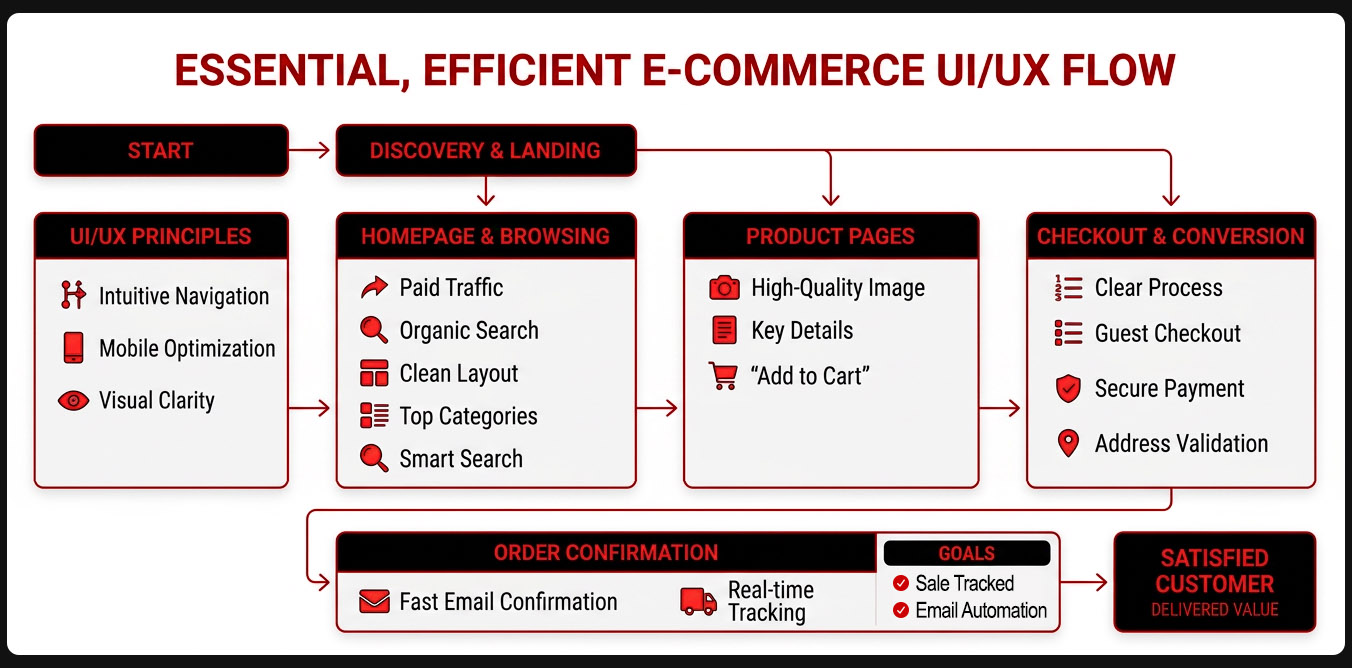
People land on the site and immediately understand what the business sells, who it’s for, and what they need to do next. They can browse products without getting lost, compare options easily, and complete a purchase without running into unnecessary problems. There’s no confusion, no second-guessing, and no unnecessary steps.
That sounds basic, but a surprising number of online stores get this wrong.
A well made, professional e-commerce website should guide people forward without making them think too hard about where to click next.
That includes the smaller details too. Mobile layouts need to work properly. Search functions need to return accurate results. Checkout pages should feel fast and secure. Shipping information, return policies, and contact details should be easy to find because people look for those signals before they commit to buying.
The highest-converting stores aren’t necessarily the flashiest ones: they’re the ones that remove obstacles and make the entire process feel smooth from the first click to the final checkout screen regardless of vibe or style.
How Too Many Choices Can Kill Momentum
It’s tempting to offer everything. More products, more variations, more options. It feels like giving customers freedom.
On paper, it sounds like a good thing. Customers get flexibility and more chances to find what they want. But on many e-commerce websites, the opposite happens.
But, too many options can slow people down, and cause hesitation to click “checkout”.
When visitors are faced with endless product grids or dozens of similar choices, they start comparing everything. They open multiple tabs, second-guess their decision, and spend more time thinking instead of buying. Often, they leave without purchasing anything at all.
Good e-commerce website designers understand how to simplify the experience without limiting the business itself. Sometimes that means reducing distractions, restructuring collections or improving search and filtering tools. Other times, it means helping people focus on a smaller number of high-performing products first.
Successful stores are intentional about their product offering. They curate. They highlight bestsellers. They guide attention toward what matters most.
It’s not about having less, it’s about making decisions easier.
If You Have Scale, You Need Structure
Of course, some stores need a large catalog. That’s where organization becomes critical.
Customers should be able to narrow down options quickly:
- By category
- By price
- By features or attributes
- By popularity or relevance
Some e-commerce businesses genuinely need large product catalogs and that’s normal. A growing store often expands into new categories, product lines, or variations over time.
A professional e-commerce website needs to help people filter through large amounts of information without making the process feel complicated. The more products a business offers, the more important navigation and organization become.
Proper filtering tools save people time. So do accurate search functions and clear category structures. When those systems work properly, customers feel in control instead of frustrated.
Good e-commerce website designers focus on clarity at every stage of the customer journey. Menus stay clean. Categories stay logical. Search tools stay useful. Product pages stay easy to compare.
A well-structured store turns complexity into something customers can move through comfortably. When people can quickly find the right product without getting frustrated, they are much more likely to buy!
Why Performance Is the Silent Dealbreaker
You can get everything else right, but if your site performs poorly and loads slow, it won’t matter.
Performance is one of the most overlooked factors in e-commerce success.
This impacts more than just user experience:
- Customers are less likely to stay and browse
- Conversion rates drop with every second of delay
- SEO rankings suffer due to poor performance metrics
Pages that take too long to load, buttons that lag, images that jump around while the page loads, and mobile layouts that freeze or behave strangely are all issues that create frustration almost immediately, especially for people browsing on their phones during short breaks, commutes, or busy days.

Most customers won’t complain about it either: they simply leave.
People are less likely to browse multiple pages when a site feels slow. Conversion rates often drop with every extra second of delay. Search rankings can also suffer because Google now pays close attention to website performance and mobile usability.
A skilled e-commerce developer looks beyond appearance alone. They pay attention to how the site actually performs under real conditions, particularly on mobile devices where most traffic now comes from.
When pages load quickly and everything works the way people expect, customers stay engaged longer, browse more confidently, and move toward purchase without interruption.
Fast, stable websites build trust. They feel professional. They feel reliable. And most importantly, they keep people moving toward a purchase!
How Successful Stores Give People a Reason to Return
The first sale is important. The second sale is where growth begins.
Strong e-commerce brands build small reasons for people to come back. Sometimes it is practical. Sometimes it is based on timing. They don’t just focus on acquisition – they focus on retention. They create reasons for customers to come back. Often it is simply about staying present in a customer’s mind without being intrusive.
This can take different forms:
- Offering complementary or related products
- Running limited drops or seasonal releases
- Highlighting exclusive or hard-to-find items
- Building perceived value through content and brand identity
For small business e-commerce owners, this matters because repeat customers are often more reliable than new ones. They already trust the business. They already understand the product quality. They are less sensitive to small changes in price or competition.
When a store becomes the obvious choice for a certain type of product, repeat business follows naturally.
And repeat customers are always more valuable than one-time buyers.
Growth Doesn’t Happen at Launch
One of the biggest misconceptions about e-commerce is that success happens immediately after launch.
In reality, most successful stores grow over time.
- They build traffic through SEO and content creation
- They engage audiences through social media with consistency
- They educate and attract customers through content that connects with them
Blogs, videos, email campaigns, and ongoing optimization all play a role. Each piece adds momentum. Each improvement compounds.
Without this post-launch effort, even well-built stores can stall.
What High-Performing E-Commerce Stores Get Right
Successful e-commerce stores consistently focus on:
- Clear navigation and frictionless purchasing
- Curated product offerings that reduce decision fatigue
- Strong filtering and organization for larger catalogs
- Fast load times and performance optimization
- Retention strategies that bring customers back
- Ongoing marketing and content to drive growth
These elements work together to create momentum, not just a functional store, but a profitable one.
The difference between a successful e-commerce store and a dead one isn’t luck, and it’s rarely the product.
It’s the experience.
Stores that are easy to use, fast to load, and intentional in how they guide customers will always outperform those that aren’t. Add in a strategy for retention and long-term growth, and the gap becomes even wider.
A great e-commerce store doesn’t just exist. It works consistently, quietly, and effectively to turn visitors into customers and customers into repeat buyers.
Ready to give your e-commerce experience a boost? Contact us today and we’ll give you some clear next steps.